`Morbid`, `Bloody`, `Perverted`, `Depraved` are words I often hear about Elisabetta Cassari's tarot
decks from a large tarot audience, who prefer butterflies, flowers and unicorns depicted on their
tarot decks. Let me say it directly: I'm an admirer of Elisabetta Cassari's work. She is my top
favorite tarot artist among a number of other favorites. I like her tarot decks. I find them artistic
and interesting in all ways, reflecting the artist's feelings about the modern society that surrounds
her. It is not an idealized and romanticized picture of the world we live in, like we find it in many
modern tarot decks; Cassari`s tarots show us our modern political world, as it is in reality.
35 years old Elisabetta Cassari (1990) is herself not astonished by this characterization.
It is true, that her art is morbid, she says. And she does not find it being a
negative trait, rather the contrary. As for the apparent sadistic and masochistic traits in her art,
Elisabetta Cassari acknowledges, that creativity is a form of psychotherapy; these traits are not
more alien to her nature, than they are, more or less, to most human beings. Elisabetta is, however,
of the opinion that she express her feelings at best through her art proper. Explanations and
intellectual interpretations she prefers to leave to the onlooker.
 As a source of inspiration for her art, she tells me, that she is attracted to the visual
expressions, which can be found in medieval and ancient books dealing with magic, demonology and
the like. She is interested in esotericism and parapsychology, but her attraction is mainly to
the visual and aesthetic expressions of the themes. She has created several tarot decks, but is
not herself a tarot reader; she finds that it must be extremely difficult to do that well. Elisabetta
is mainly attracted to tarot as an artistic and aesthetic art form, an attraction that has led her
to create a graphic imagery of a world, in which we can recognize traits of our own lives and
surroundings. The only books dealing with tarot she has ever read are Oswald Wirth's "The Tarot of
the Magicians" and Italo Calvinos "Castle of Crossed Destiny". It doesn't seem that any of the modern
American writers on tarot are translated into Italian, and she has therefore not read works by
Mary Greer, Rachel Pollack or any other contemporary tarot writer. As for tarot decks, Elisabetta
prefers the ancient traditional packs. She owns a number of the decks published by Edition Solleone,
but there is no particular deck she feels has been an inspiration for her.
As a source of inspiration for her art, she tells me, that she is attracted to the visual
expressions, which can be found in medieval and ancient books dealing with magic, demonology and
the like. She is interested in esotericism and parapsychology, but her attraction is mainly to
the visual and aesthetic expressions of the themes. She has created several tarot decks, but is
not herself a tarot reader; she finds that it must be extremely difficult to do that well. Elisabetta
is mainly attracted to tarot as an artistic and aesthetic art form, an attraction that has led her
to create a graphic imagery of a world, in which we can recognize traits of our own lives and
surroundings. The only books dealing with tarot she has ever read are Oswald Wirth's "The Tarot of
the Magicians" and Italo Calvinos "Castle of Crossed Destiny". It doesn't seem that any of the modern
American writers on tarot are translated into Italian, and she has therefore not read works by
Mary Greer, Rachel Pollack or any other contemporary tarot writer. As for tarot decks, Elisabetta
prefers the ancient traditional packs. She owns a number of the decks published by Edition Solleone,
but there is no particular deck she feels has been an inspiration for her.
 Elisabetta Cassari has a formal art education from the Brera Academy of Milan, but she is also an
art teacher in a secondary school. She finds that her art goes along very well with her teaching,
and that even her particular style sometimes fits into the school work. She does not want to define
herself as primarily an artist, but she considers the school work to be her profession, a profession
that allows her enough spare time and the necessary economical basis to practice and cultivate her art.
Elisabetta Cassari has a formal art education from the Brera Academy of Milan, but she is also an
art teacher in a secondary school. She finds that her art goes along very well with her teaching,
and that even her particular style sometimes fits into the school work. She does not want to define
herself as primarily an artist, but she considers the school work to be her profession, a profession
that allows her enough spare time and the necessary economical basis to practice and cultivate her art.
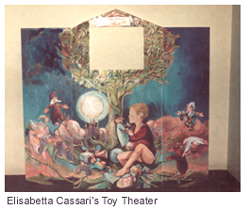
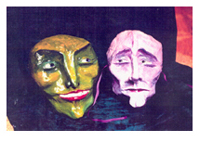
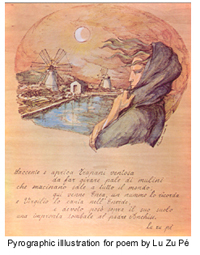
Apart from working with drawings and paintings, Elisabetta Cassari has also experimented with
pyrographic art*), of which she recently had an exhibition in Sicily. She also likes sculpturing,
and especially working with masks and puppets, because they also give the possibility to work with
colors at the same time. Like Pamela Colman Smith she made her own toy theatre to use with the
puppets, as well as making illustrations for fairy tales. Elisabetta has so far not aimed at
having her works published, nor has she been particularly interested in being represented in
galleries or collections. She however, feels that this attitude of hers has changed lately, so
maybe we will see more of her works in the future.
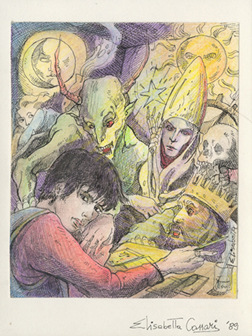
 I have asked Elisabetta if she ever rendered herself as a person in one or more of her tarot decks.
The question became obvious to me, when I, at one of my tarot workshops illustrated by slides, showed
Il Mondo (The World) from "Gli Arcani di Elisabetta"; this card depicts an execution attended by
numerous people. One of them is looking away from the execution scene, and instead looks directly at
us. I got the idea, that this was actually a self-portrait of Elisabetta. I asked her, but it was not;
actually she was not sure if the figure was a woman at all. So instead she kindly sent me the
self-portrait shown at the top of this article: Elisabetta in her world of tarot, surrounded by her
tarot figures.
I have asked Elisabetta if she ever rendered herself as a person in one or more of her tarot decks.
The question became obvious to me, when I, at one of my tarot workshops illustrated by slides, showed
Il Mondo (The World) from "Gli Arcani di Elisabetta"; this card depicts an execution attended by
numerous people. One of them is looking away from the execution scene, and instead looks directly at
us. I got the idea, that this was actually a self-portrait of Elisabetta. I asked her, but it was not;
actually she was not sure if the figure was a woman at all. So instead she kindly sent me the
self-portrait shown at the top of this article: Elisabetta in her world of tarot, surrounded by her
tarot figures.
For the benefit of our astrological minded readers I also asked Elisabetta about her attitude towards
astrology. She does not believe very much in it, she says, but in spite of that she will
characterize herself as an Aquarius character with a Gemini ascendant and Moon in Scorpio. So the
astrologers amongst our readers now can decide by themselves if that is compatible with Elisabetta's
artwork!
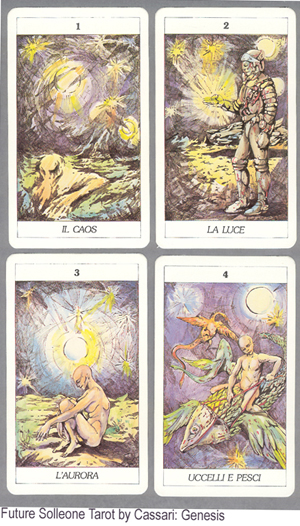
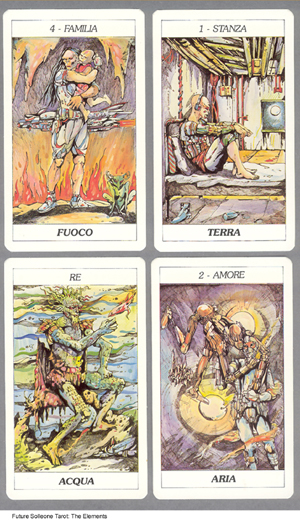
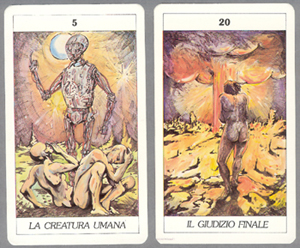
Elisabetta Cassari created three tarot decks: `Solleone Tarot` (1983), `Gli Arcani di Elisabetta`
(1986) and `Future Solleone Tarot` (1987). All three decks were published by the Italian publisher
and collector, Vito Arienti who, with his series `Editions Solleone', has made numerous modern
tarot and playing cards and reprints of historical packs accessible to the tarotist and collector.
It was Vito Arienti, who introduced not only Elisabetta Cassari but also Amerigo Folchi to tarot
and encouraged them in their careers as tarot artists.
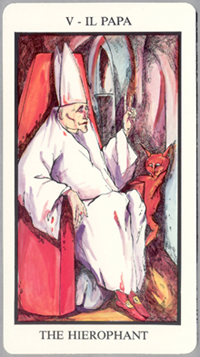
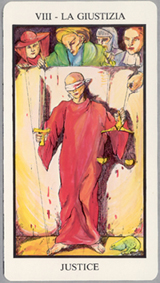
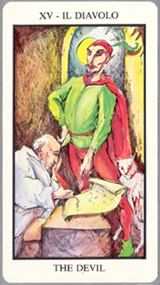
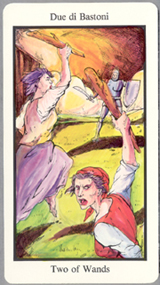
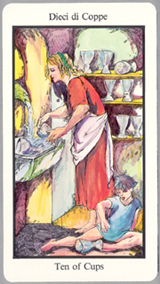
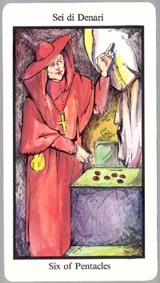
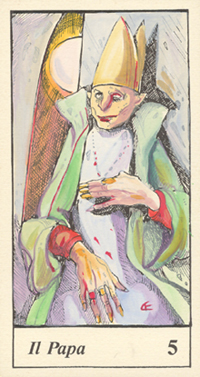
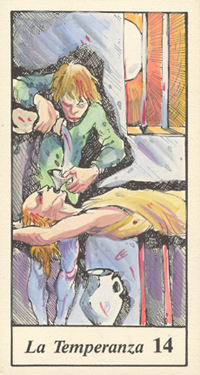
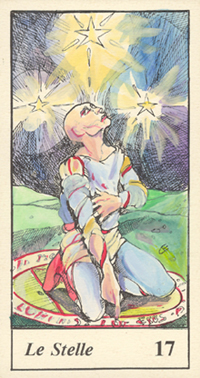
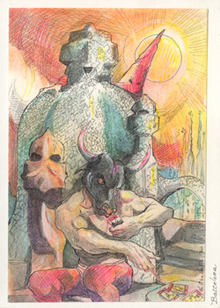
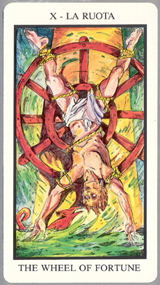 Elisabetta's major arcana is in general blood-dripping. It represents the governing classes. Justice
is suppressed, blindfolded, a string puppet controlled by influential people of the society. Strength
is not strength obtained by inner balance, it is strength expressed through raw violence. Temperance
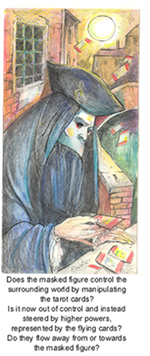
is turned to greed and desire. The scientists are selling their souls to Mephistopheles. The Magician
has lost contact with the higher forces. The Wheel of Fortune has no balance; you are sold out. Minor
arcana shows us the victims of this rulership and its influence. The coin or pentacle suit shows how
money came to rule the world. It is a story of greed and treachery, of bribery and swindling. The
sword suit is again pictures of the blood-dripping suppression. The wands are the heavy burdens carried
by the ordinary people, and yet there are attempts of resistance, but doomed to failure. The cups are
filled up with blood. Only in the ten of cups a poor woman is trying to wash them clean.
Elisabetta's major arcana is in general blood-dripping. It represents the governing classes. Justice
is suppressed, blindfolded, a string puppet controlled by influential people of the society. Strength
is not strength obtained by inner balance, it is strength expressed through raw violence. Temperance
is turned to greed and desire. The scientists are selling their souls to Mephistopheles. The Magician
has lost contact with the higher forces. The Wheel of Fortune has no balance; you are sold out. Minor
arcana shows us the victims of this rulership and its influence. The coin or pentacle suit shows how
money came to rule the world. It is a story of greed and treachery, of bribery and swindling. The
sword suit is again pictures of the blood-dripping suppression. The wands are the heavy burdens carried
by the ordinary people, and yet there are attempts of resistance, but doomed to failure. The cups are
filled up with blood. Only in the ten of cups a poor woman is trying to wash them clean.
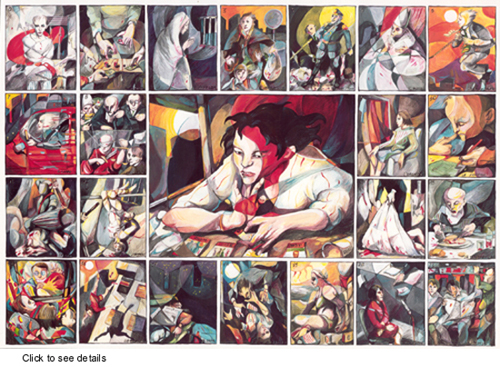
 Recently another full set of majors were painted in acrylics on a large cardboard,
centered around another (likely) self-portrait of the artist. Elisabetta generously allowed this
illustration to be reproduced as a full color page with this article (see the end of this article).
Recently another full set of majors were painted in acrylics on a large cardboard,
centered around another (likely) self-portrait of the artist. Elisabetta generously allowed this
illustration to be reproduced as a full color page with this article (see the end of this article).
|
First published in Manteia #3, April 1990.
|
*) Pyrographic art - illustrations burned into wood
**) Elisabetta Cassari's hand coloring of the planned 99 decks stopped somewhere along the line; to
color 99 x 23 cards by hand is a lengthy and extremely tedious affair. The demand for the, naturally
rather costly deck, was probably too low at the time. The remaining decks were later sold without
colors.
***) I attempted to contact Elisabetta Cassari several times during the last few years, but in vain.
I have not been able to locate her. Not even Vito Arienti shortly before his death, knew her present
address, nor did other people I contacted. Unconfirmed rumors say, that Cassari left Italy and moved
to France or Spain (likely the latter since she speaks Spanish). If anyone knows about her current
whereabouts, I'll be pleased to learn about them!
This site designed & maintained by
Arnell's Art
All contents contributed by K. Frank Jensen
|